
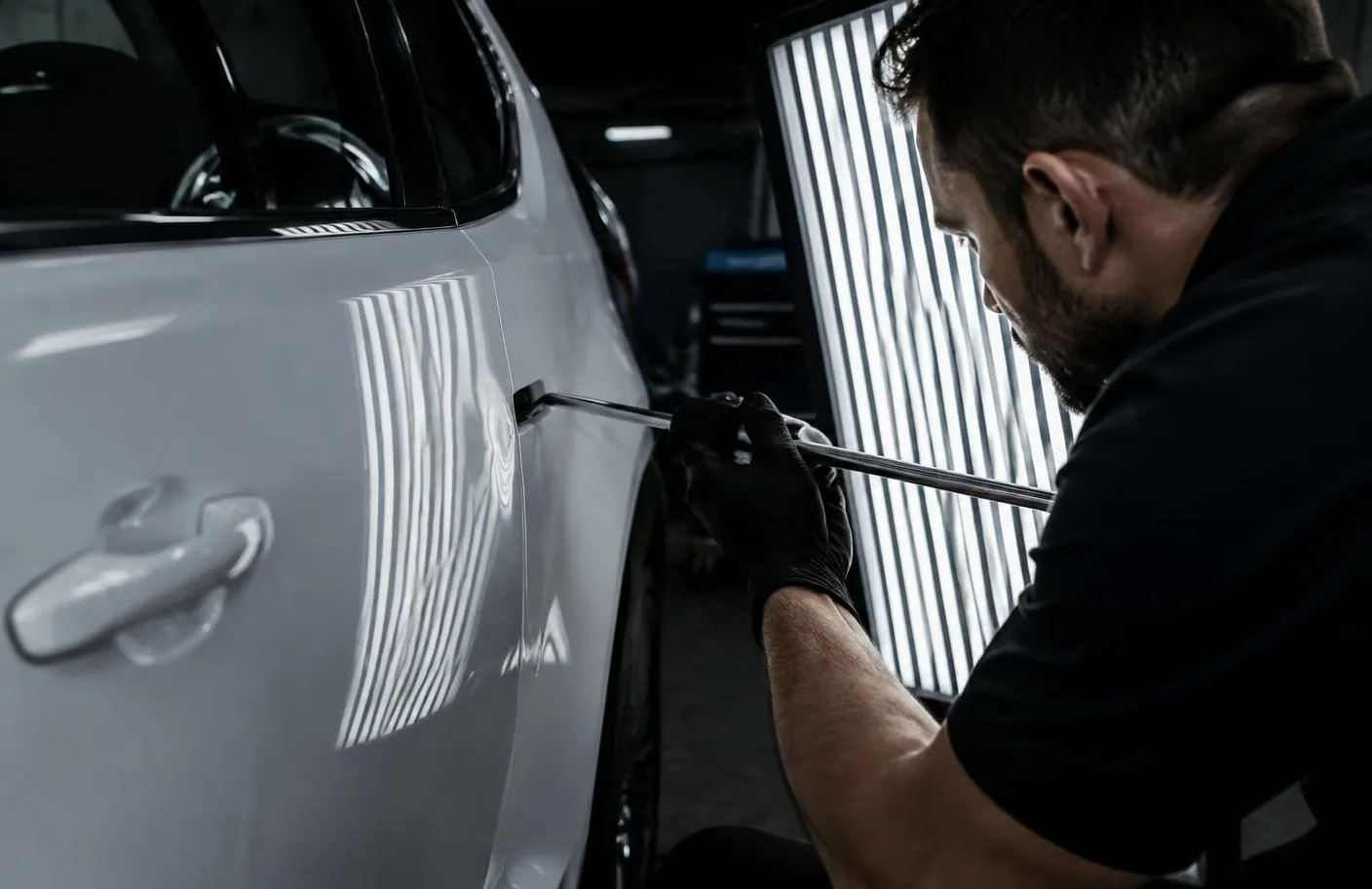
PDR (dent repair) in Salt Lake City typically runs about $125 on average for a small door ding, around $200 for a larger dent (up to $750 for harder ones), and from about $500 to $7,000 for hail damage, based on published Salt Lake area price pages. The real cost of your dent depends on its size, depth, location and access, which is why the most reliable number comes from a quote based on photos of your actual damage.
TL;DR
- Published Salt Lake area pages cite about $125 on average for a small door ding, with larger or harder dents running $200 to $750.
- Hail repair is priced panel by panel and is cited at about $500 to $7,000 depending on panels, dents and vehicle.
- Sharp creases, stretched metal, body lines, aluminum panels and hard-to-reach spots raise the cost.
- Send damage photos to JNG Auto Reconditioning for a free dent repair quote in Salt Lake City.
How much does dent repair (PDR) cost in Salt Lake City?
PDR is a dent repair method where a technician massages a dent out from behind the panel, or pulls it from the front, without filling, sanding or repainting. Because there is no paint work, it usually costs less than traditional bodywork when the dent qualifies.
Published price pages from shops in the Salt Lake Valley give a useful picture of typical industry ranges. These are not JNG's prices. They are a starting point so you know what ballpark to expect before you request a quote.
JNG Auto Reconditioning does not use a fixed price list. Every dent repair is quoted per photo: you send pictures of your actual dent, and JNG replies with a price for that damage. The fastest way to know what your dent will cost is to send photos for a free dent repair quote.
| Type of damage | Typical published range | What drives the price |
|---|---|---|
| Small door ding (dime to quarter size) | About $125 average at one shop; another lists $150 for the first dent per panel | Depth, location and whether the panel is easy to reach |
| Larger dent | Around $200 average at one shop, with harder dents $200 to $750 at another | Size, sharpness, body lines and how stretched the metal is |
| Additional dents on the same panel | Discounted at some shops, such as an extra $75 to $100 per additional dent on the same panel | How many dents share the same access point |
| Hail damage (whole vehicle) | About $500 to $7,000; one shop cites a $2,500 average, with many repairs under $1,000 and some over $5,000 | Number of panels, number and size of dents, vehicle type |
| Dent with damaged paint | Usually priced as traditional bodywork | Filler, sanding, primer, paint and blending |
Typical industry ranges from published Salt Lake area price pages reviewed November 2026. See the sources note at the end of this guide. Your quote depends on your vehicle and damage.
The best way to read these ranges: a shallow, round dent on a flat, reachable panel sits at the low end. A sharp, deep or hard-to-reach dent sits at the high end, or may not be a PDR candidate at all.
What makes one dent cost more than another?
Two dents that look the same size can be priced very differently. A technician is not just measuring the dent. They are judging how much time and control the repair will take.
Sharp creases and body lines
A soft, round dent spreads the damage over a wide area, and the metal can often be worked back smoothly. A sharp crease concentrates the damage in a narrow line. Dents that sit on or across a body line, the styled ridges on doors and fenders, are harder because the technician has to restore the exact shape of that line.
Stretched metal
When an impact pushes metal far enough, it stretches. Stretched metal has more surface area than it started with, so it cannot simply be pushed back flat. Some stretched dents can still be improved with PDR, while others need traditional bodywork to look right.
Hard-to-reach panels
PDR often works from behind the panel. If braces, inner structures or electronics block access, the technician may need to remove trim, lights or interior panels, or switch to pulling the dent from the outside. More access work usually means more cost.
Panel material and vehicle type
Aluminum panels, common on many newer trucks and some luxury vehicles, behave differently from steel and are generally harder to repair. Published guides also note that vehicle type affects price.
Paint condition
If the paint is cracked, chipped or scraped, PDR alone cannot fix the finish. That damage moves into traditional repair with refinishing, which changes the price and the timeline.
How are multiple dents and hail damage priced?
Multiple dents are rarely priced as simple multiplication. Many shops publish a discount for additional dents, especially on the same panel, because the technician is already set up with access to that area. One Salt Lake shop describes its second, third and fourth dents as getting progressively cheaper.
Hail is a different category. Instead of pricing one dent at a time, hail repair is usually estimated panel by panel, based on how many dents are on each panel and how large they are. A car that was partly covered during a storm may have heavy damage on the roof and hood and almost none on the doors. That is why hail repair estimates vary so widely, from under $1,000 to well over $5,000 on badly damaged vehicles.
Salt Lake City and the Wasatch Front see summer thunderstorms that can drop hail, so hail repair is a regular need here. If hail hit your car, it is worth having every panel checked, including the roof, which is easy to miss from the ground.
Is PDR cheaper than traditional bodywork?
Usually, yes, when the dent qualifies. Traditional dent repair typically involves pulling or hammering the metal, applying filler, sanding, priming, painting and blending the color into nearby panels. Each of those steps adds labor and materials.
| Factor | PDR | Traditional bodywork |
|---|---|---|
| Original paint | Kept in place | Sanded and refinished |
| Typical cost for a small dent | Lower | Higher, because of paint and materials |
| Typical turnaround | Often a few hours for minor dents | Often one or more days, including paint cure time |
| Best for | Dents with intact paint and good access | Sharp, stretched or paint-damaged dents |
Published local guides describe minor PDR repairs being finished in a few hours, while larger traditional repairs can take a day or two or longer. Keeping the factory finish can also matter when you sell or trade in the vehicle, because there is no repaint to explain.
PDR is not always the right answer. If the paint is broken or the metal is badly stretched, traditional repair can produce the better result, and a good shop should tell you so.
Will insurance pay for dent repair?
It depends on your policy and how the dent happened. Hail damage is generally handled under comprehensive coverage, while a dent from hitting another vehicle or object usually falls under collision coverage. In both cases your deductible applies.
That makes the deductible the key number for small dents. If a door ding costs less than your deductible, paying out of pocket usually makes more sense than filing a claim. For hail, where repair totals can run into the thousands, a claim is often worth considering.
Your insurance company and policy documents are the final word on what is covered. If you plan to file a claim, take clear photos of the damage first and keep any repair estimates you receive.
Why do photo estimates for dents vary?
A photo shows the shape of the dent, but it cannot always show its depth, how sharp the edges are, whether the metal is stretched or what is behind the panel. Lighting matters too. A dent that looks shallow in bright daylight can look deeper under shop lights that reveal every ripple.
That is why one shop's photo estimate can differ from another's, and why a final price can change after an in-person look. A photo quote is still the fastest way to learn whether your dent is a good PDR candidate and what range to expect.
How does JNG's photo quote work?
JNG Auto Reconditioning offers free quotes through the website, and you can include photos of the damage. To get the most useful quote:
- Photograph the dent straight on from about three feet away.
- Take a second photo at an angle, so the reflection shows the shape of the dent.
- Add a wide photo of the whole panel so the location is clear.
- Mention anything else you noticed, such as chipped paint or a crease.
JNG reviews the photos and lets you know the recommended repair approach. If the damage needs a closer look, the next step is an in-person assessment at the shop in Salt Lake City.
Where is JNG located in Salt Lake County?
JNG Auto Reconditioning is at 537 W Pickett Circle #300, Salt Lake City, and serves drivers across Salt Lake County. Learn more on the dent repair in Salt Lake City page.
FAQ
How much does it cost to fix a small door ding with PDR?
Published Salt Lake area price pages cite about $125 on average for a small door ding, and one shop lists $150 for the first dent on a panel. Your actual price depends on the dent's depth, location and access.
How much does hail damage repair cost in Salt Lake City?
Published local ranges run from about $500 to $7,000. One shop cites a $2,500 average, with many repairs under $1,000 and some over $5,000. Hail is usually priced panel by panel based on the number and size of dents.
Is PDR cheaper than a body shop repair?
Usually, when the dent qualifies. PDR keeps the original paint, so there is no filler, sanding or repainting, which reduces labor, materials and turnaround time.
Can every dent be fixed with PDR?
No. Dents with cracked or chipped paint, very sharp creases or badly stretched metal may need traditional bodywork. An inspection or photo review helps decide.
Should I file an insurance claim for a dent?
It depends on the repair cost compared with your deductible. Small dings often cost less than a deductible, while hail damage is often worth a claim under comprehensive coverage. Check your policy.
How long does PDR take?
Many minor dents can be repaired in a few hours. Larger dents and hail damage take longer depending on how many panels are involved.
Can I get a dent repair quote by sending photos?
Yes. You can request a free quote through JNG's website and include damage photos. Some dents still need an in-person look to confirm depth and access.
One last thing: ask what kind of repair you are being quoted
When you compare dent repair quotes, check that you are comparing the same kind of repair. A PDR quote and a traditional bodywork quote for the same dent can be very different, and both may be honest. Ask whether the original paint stays, how long the repair takes and what could change the price.
For dent repair in Salt Lake City, request a free photo quote, or call JNG Auto Reconditioning at (385) 346-8803.
Price sources, reviewed November 19, 2026: Salt Lake Dent Repair pricing page (saltlakedentrepair.com/prices); Wasatch PDR services page (wasatchpdr.com/services). Ranges are typical industry figures, not JNG Auto Reconditioning's prices.